AI Citations vs Google Rankings: The New Search Rules
The Disconnect Between Organic Rankings and AI Citations
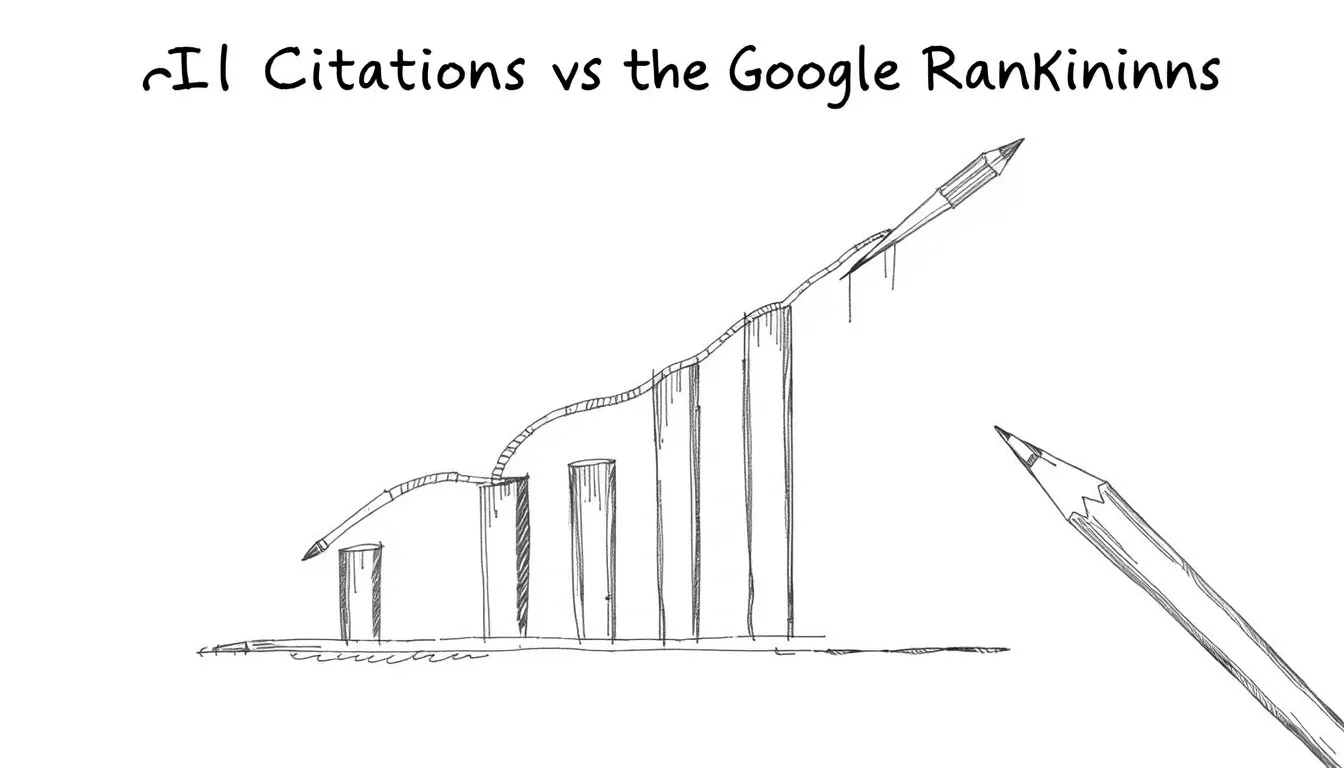
Recent research highlights a massive evolution in search behavior: the correlation between top organic Google rankings and AI-generated citations has dropped sharply to 37.9%. Previously standing above 70%, this shift demonstrates that ranking in the top ten results for a primary keyword no longer guarantees inclusion in Google AI Overviews or external assistants like ChatGPT, Gemini, and Perplexity. A major driver of this change is a process known as query fan-out. Modern generative search systems deconstruct a single user query into multiple specific sub-questions. Instead of citing a high-ranking general page, AI algorithms pull citations from pages that answer these specific sub-questions with absolute precision, even if those pages rank lower organically. Furthermore, performance varies widely across platforms. Perplexity aligns with Google’s top organic results roughly 29% of the time due to its unique index, while platforms like ChatGPT overlap at an average of just 12%. Digital teams must recognize that organic ranking and AI citation visibility are now distinct operational goals.
Risks, Shortcuts, and the Limits of Search Automation
As search engines shift toward direct extraction, traditional optimization playbooks face serious risks. Relying solely on primary keyword positions can cause brands to lose significant exposure to lower-ranking competitors who address specialized sub-topics effectively. At the same time, attempting to game retrieval algorithms with artificial shortcuts often backfires. Inundating a site with low-quality text produced by an AI content generator fails to earn citations because generative engines prioritize clear evidence, original metrics, and expert analysis over generic summaries. Similarly, attempting to elevate domain authority overnight using an auto backlink tool provides little value when search platforms select sources based on direct semantic context rather than sheer link numbers. Additionally, formatting tricks like arbitrarily truncating articles offer no advantage, as Google’s official guidance confirms that standard indexing infrastructure powers its AI features. The core risk today is measuring success purely through traditional organic clicks while failing to monitor citation frequency across multiple distinct large language models.
Actionable Frameworks for Winning AI Search Exposure
To adapt to this shifting landscape, publishers must update their editorial and technical workflows. First, conduct thorough sub-topic research around primary keywords to identify the exact sub-questions retrieval systems extract. Instead of rewriting complete articles from scratch, enrich existing pages with primary data, transparent methodologies, and clear citations that serve as extractable proof points. Second, keep factual statements and statistical references up to date, as stale data frequently disqualifies otherwise authoritative pages during real-time retrieval. Third, tailor strategies to specific platforms rather than assuming a single optimization effort covers all engines. Because ChatGPT, Perplexity, and Google utilize distinct retrieval pipelines and content partnerships, monitoring brand presence on each engine independently is essential. Finally, shift team key performance indicators from unified rank tracking to separate metrics for organic traffic and generative source mentions. By delivering depth and verifiable facts, brands ensure their content remains indispensable to modern generative answer engines.